


#NEWS · Live feed
Colombia: after the Cartagena hostage-taking, has violence risen under De la Espriella? What the numbers say

By NAGO News
3 min read
Armed, hooded men were still holding about 20 people overnight Tuesday into Wednesday in an Éxito supermarket in the La Castellana district of Cartagena, the Colombian Caribbean’s main tourist city. According to police, they barricaded themselves inside on the morning of Tuesday, 24 November, after a failed attack on an armoured truck. About ten hostages had been freed by the evening. President Abelardo de la Espriella, who went to the scene, gave them until 12:30 a.m. to release the hostages and called them “common criminals”. At the time of publication, no outcome had been confirmed.
The day before, on Monday, 23 November, a car bomb exploded outside the Meta governor’s office in Villavicencio, injuring at least 23 people. The president blamed dissidents of the former FARC guerrillas. Such images suggest a country sliding into violence since the president took office on 7 August. The numbers tell a more nuanced story.
In his first three months (August to October 2026), compared with the same period in 2025, homicides fell by about 9 percent, kidnapping victims by 59 percent and armed clashes by 62 percent, according to official data analysed by the Colombian outlet La Silla Vacía. The Fundación Ideas para la Paz (FIP) also reports a drop of nearly 11 percent in homicides in August and September.
What has risen is armed groups’ attacks on the state. Terrorism cases went from 39 to 96 over the same period, explosive-drone attacks from 4 to 48, and attacks on infrastructure rose by 44 percent. Bomb and drone attacks, sometimes in cities, are far more visible than a homicide in a rural area.
This is no coincidence. On 11 September, Abelardo de la Espriella closed every negotiating table of the “total peace” launched by his predecessor, Gustavo Petro, and launched a military offensive, including airstrikes against dissident groups. According to the monitoring group ACLED, August 2026 was the deadliest month for clashes between the state and armed groups since its records began in 2018. International Crisis Group analyst Elizabeth Dickinson says the armed groups are trying to “raise the costs” of the offensive for the government, including by harming civilians.
The violence did not start with the new president. In 2025, under Gustavo Petro, Colombia recorded 14,780 homicides, the highest figure in a decade according to the national forensic institute. The year began with the Catatumbo crisis, where fighting left more than 80 dead and 32,000 displaced, and saw the assassination of candidate Miguel Uribe Turbay. According to the NGO Indepaz, 80 of the 97 massacres recorded in 2026 up to 9 October took place before 7 August, under Petro.
During “total peace”, fighting between the state and armed groups had fallen, but the groups expanded and grew stronger, according to ACLED. They now have about 29,000 members, according to the FIP. The FIP nevertheless says it is “impossible” to measure the new policy’s real effect after only 100 days, and notes that less violence does not necessarily mean the armed groups have lost control of territory.
Videos
Watch now.
Reporting by El Tiempo, prise d’otages à l’Éxito de Cartagena, direct (24-25 nov. 2026)
Publimetro, « Éxito Cartagena : liberan a 10 rehenes » (24 nov. 2026)
Al Jazeera, voiture piégée à Villavicencio (24 nov. 2026)
La Silla Vacía, chiffres de sécurité après 100 jours (19 nov. 2026)
Fundación Ideas para la Paz, via EFE / La Patria (16 nov. 2026)
ACLED, « Total peace, prison or death » (2 sept. 2026)
El Colombiano, fin de la « paix totale » (11 sept. 2026)
Infobae, début 2026 le plus violent de la décennie (2 avr. 2026)
El Colombiano, 14 780 homicides en 2025
ACLED, « Total peace paradox » (28 nov. 2024)
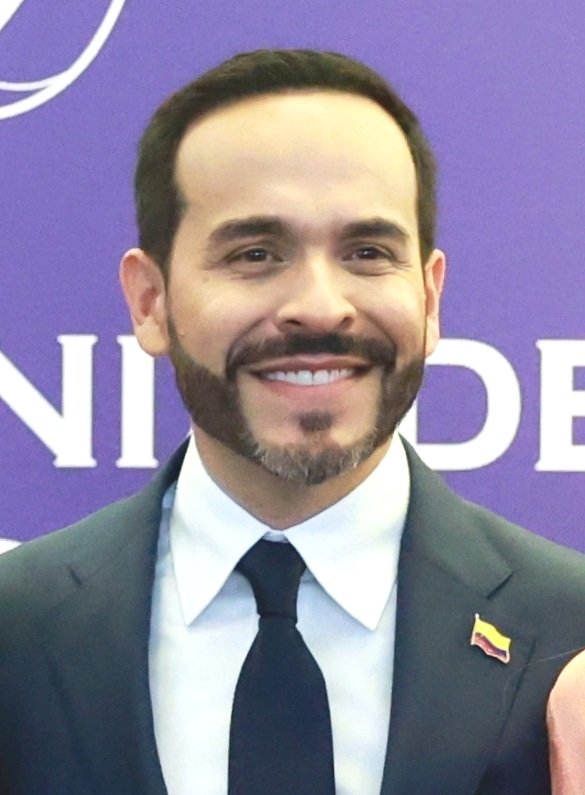
Wikimedia Commons, photo d’Abelardo de la Espriella (CC0)
 Mexico to try “El Chapo Isidro” at home despite US extradition requestMexico will try Fausto Isidro Meza Flores, known as “El Chapo Isidro” and described as a drug-trafficking boss, at home despite a …Three Salvadoran soldiers killed: Haiti's police chief offers condolences to the contingentThe acting director general of the Haitian National Police (PNH), André Jonas Vladimir Paraison, paid a condolence visit on Tuesda…Abinader receives Albert Ramdin to request increased regional support for Haitian securityDominican President Luis Abinader received Albert Ramdin, Assistant Secretary General of the Organization of American States (OAS)…South-East: police arrest a suspected Fontamara gang member in Côtes-de-FerThe Haitian National Police arrested Pierre Tracy Jaboin, 20, on Monday, 23 November in the commune of Côtes-de-Fer, in the South-…Gangs handing out rice: behind the images, 5.94 million Haitians face acute food insecurityVideos showing armed men handing out bags of rice to residents have been circulating on social media in recent days. NAGO could no…
Comments 0