


#ÉDITORIAL · Live feed · Ouest
Human rights do not begin with the rescuers
By La rédaction de NAGO
4 min read
"Both governments must make public the agreement governing the deployment." The words are Ana Piquer's, Amnesty International's director for the Americas. She spoke them on November 10, two days after Haitian police officers and Salvadoran soldiers destroyed the headquarters of the 400 Mawozo gang in Croix-des-Bouquets.
Let us take Amnesty at its word. Demanding transparency from those who come to defend us is legitimate. But an organization that speaks in the name of human rights should also ask itself why its most precise, most demanding, most detailed voice is heard on the very day the gangs finally retreat.
For years, it is the gangs who have been killing. They killed in Carrefour-Feuilles, in Cité Soleil, in Pont-Sondé, in Wharf Jérémie. They raped women and young girls, recruited children, burned homes and churches. They drove more than a million Haitians from their homes. They extorted market women, drivers, and workers who rise before dawn to feed their families.
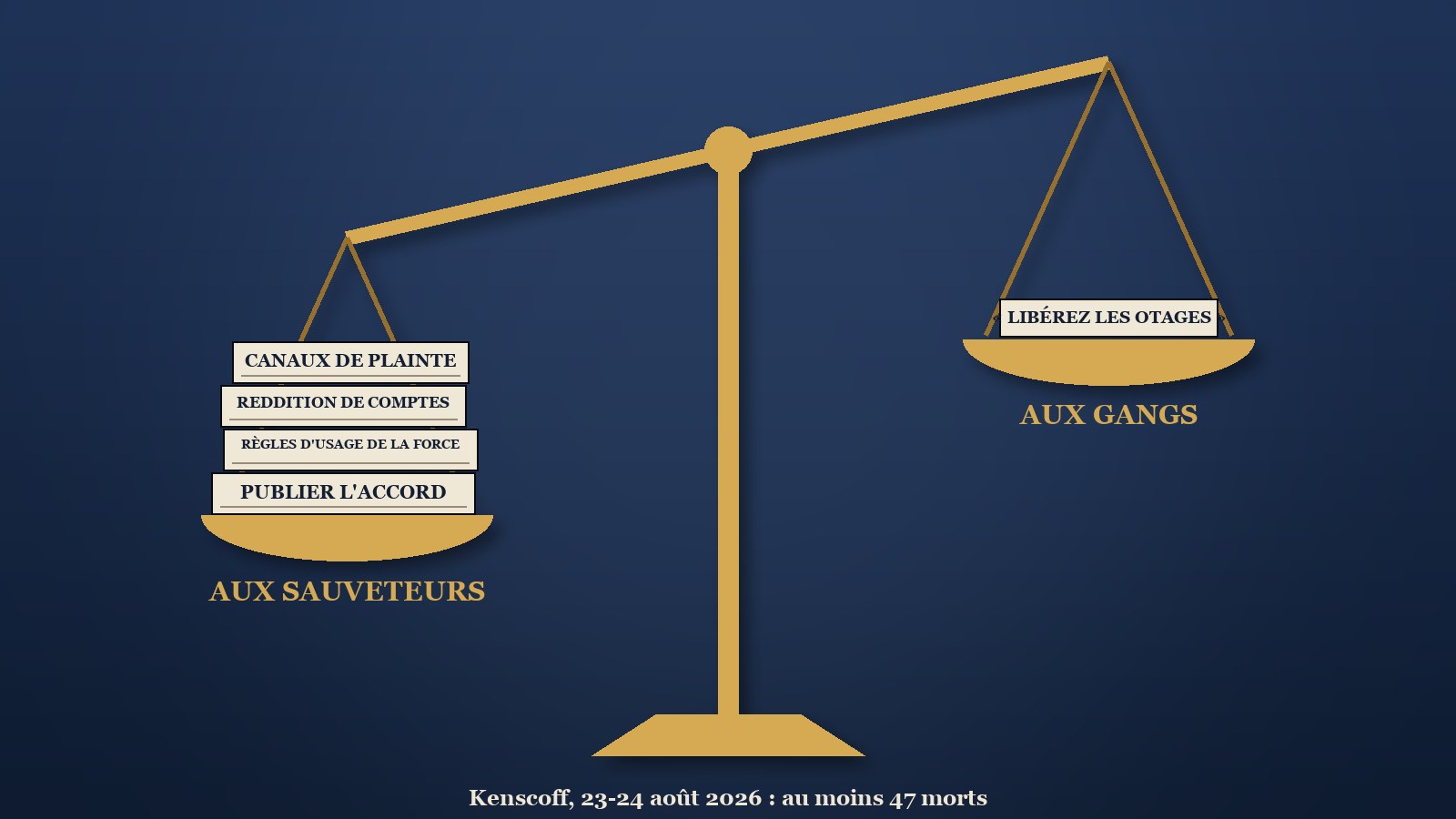
And then there is Kenscoff. On the night of August 23 to 24, 2026, some 150 heavily armed men from the Viv Ansanm coalition attacked the town. According to the UN, at least 47 people were killed, 22 of them executed inside the compound of an evangelical church where displaced families had taken shelter. More than 50 people were abducted. A gang leader then threatened to execute the hostages if the police advanced.
What did Kenscoff get? A press release. Amnesty condemned the massacre on August 26, and rightly so. It asked that those responsible be tried and that the gangs release their hostages "immediately and unconditionally." There is no sign that any gang obeyed. No leader has been tried. The dead of Kenscoff were buried in collective funerals, and life went on without them.
That is the heart of the problem. To the gangs, Amnesty addresses appeals that none of them has ever heeded. To those who fight them, it addresses precise demands: publish the agreement, define the rules on the use of force, create accountability mechanisms, open channels for complaints. The killers receive wishes; the defenders receive a list of specifications.
We will be told that Amnesty has documented the gangs' crimes. That is true. In February 2025, its report on children victimized by gangs described forced recruitment, the rape of young girls, and killings. It was fair and necessary. But a report does not make a road passable, a market safe, or a night in Kenscoff quiet. Haitians have had reports for years. What they did not have was someone to take back a gang's house.
Let us be fair. Amnesty is not calling for the Salvadoran operations to stop. It is right to recall that foreign interventions in Haiti have left abuses unpunished, from cholera to sexual violence. It is right to demand news of the four Salvadoran soldiers missing since October 18. And we will no more accept an operation that kills innocent people: the law must protect every Haitian, including from those who come to help us.
But the order of priorities matters. When a major international voice responds to a victory against the gangs by talking first about the rules imposed on the victors, the message received in Croix-des-Bouquets, in Kenscoff and in the diaspora is clear: Haitian lives only truly cause concern when others come to defend them.
We therefore ask Amnesty International for the same rigor toward those who are killing us. Let it demand, with the same precision, the names of those who finance and arm the gangs, the origin of the rifles that come in through our ports, and sanctions against the political and business figures who protect them. We also ask the Haitian government to publish the agreement with El Salvador itself, so that no one has to demand it.
Human rights do not begin on the day the rescuers arrive. In Kenscoff, they were trampled long before.
Videos
Watch now.
Reporting by Amnesty International, déclaration sur le déploiement salvadorien (10 novembre 2026)
Amnesty International, déclaration sur Kenscoff (26 août 2026)
Amnesty International, rapport sur les enfants et les gangs (12 février 2025)
The Haitian Times, attaque de Kenscoff (24 août 2026)
HNGN, funérailles des victimes de Kenscoff (2 septembre 2026)
Al Jazeera, opération contre 400 Mawozo (10 novembre 2026)
By La rédaction de NAGO
Comments 0