


New York bans tear gas at protests: what would it take in Haiti?
4 min read
On Monday 16 November, New York Mayor Zohran Mamdani and Police Commissioner Jessica Tisch announced that the Strategic Response Group (SRG), the NYPD unit that handled both protests and counterterrorism, is being disbanded. At gatherings protected by the First Amendment, police will no longer be allowed to box protesters in (the tactic known as kettling) or to use tear gas or long guns. Pepper spray is not banned, but it will no longer be used as a crowd-management tool, and sound devices will be capped at 90 decibels.
According to City Hall, protesters "should not be met with the same police response as a terrorism threat". Counterterrorism moves to another bureau, and a civilian unit with no weapons or arrest powers will handle dialogue with organisers. Civil liberties groups welcomed the decision, while calling for close oversight so that the old practices do not return under a new name.
The question is pressing in Haiti. On the same day, 16 November, in Pétion-Ville, students from the Faculty of Human Sciences (FASCH) demanding better study conditions chanted « Se pa bandi non, se etidyan wi » ("We are not bandits, we are students"). Police dispersed them with tear gas. That same day, the Haitian National Police (PNH) warned that it would enforce the law against anyone using a protest to cause disorder, and asked organisers to notify the authorities in advance.
On paper, the right exists. Article 31 of the 1987 Constitution guarantees the freedom to assemble without weapons for a peaceful purpose. NAGO found no law requiring organisers to declare a protest in advance: the PNH's request is a matter of practice rather than a legal obligation.
The key difference with New York lies in the police's mission. Since 2 May 2025, the United States has designated the Viv Ansanm and Gran Grif coalitions as terrorist organisations, and the UN sanctioned them in July 2025. In Haiti, the same under-staffed and under-equipped PNH both fights these armed groups and polices protests. New York separated the two missions. That is arguably the most transferable idea: a written doctrine for policing protests, distinct from anti-gang operations.
In Haiti, the danger goes beyond gas. On 23 February 2022, journalist Maximilien Lazard was killed when police opened fire on a protest by textile workers demanding a higher minimum wage in Port-au-Prince. On 30 October 2022, journalist Romelson Vilcin died after being struck in the head by a projectile while police fired tear gas outside the Delmas 33 police station, where journalists were demanding the release of a colleague. More broadly, according to the United Nations Integrated Office in Haiti (BINUH), about 40% of the victims, killed or injured, recorded between April and June 2026 were hit during security-force operations against armed groups.
Another difficulty: gangs themselves sometimes blur the line between protest and armed violence. In early November, the 400 Mawozo gang announced it would join a "peaceful demonstration" later in the month to prepare a national dialogue. During the 2019 "peyi lòk", researchers described barricades that were sometimes violent and armed groups that at times repressed and at times joined the mobilisations. Such episodes feed the authorities' view that any protest may be hiding a gang.
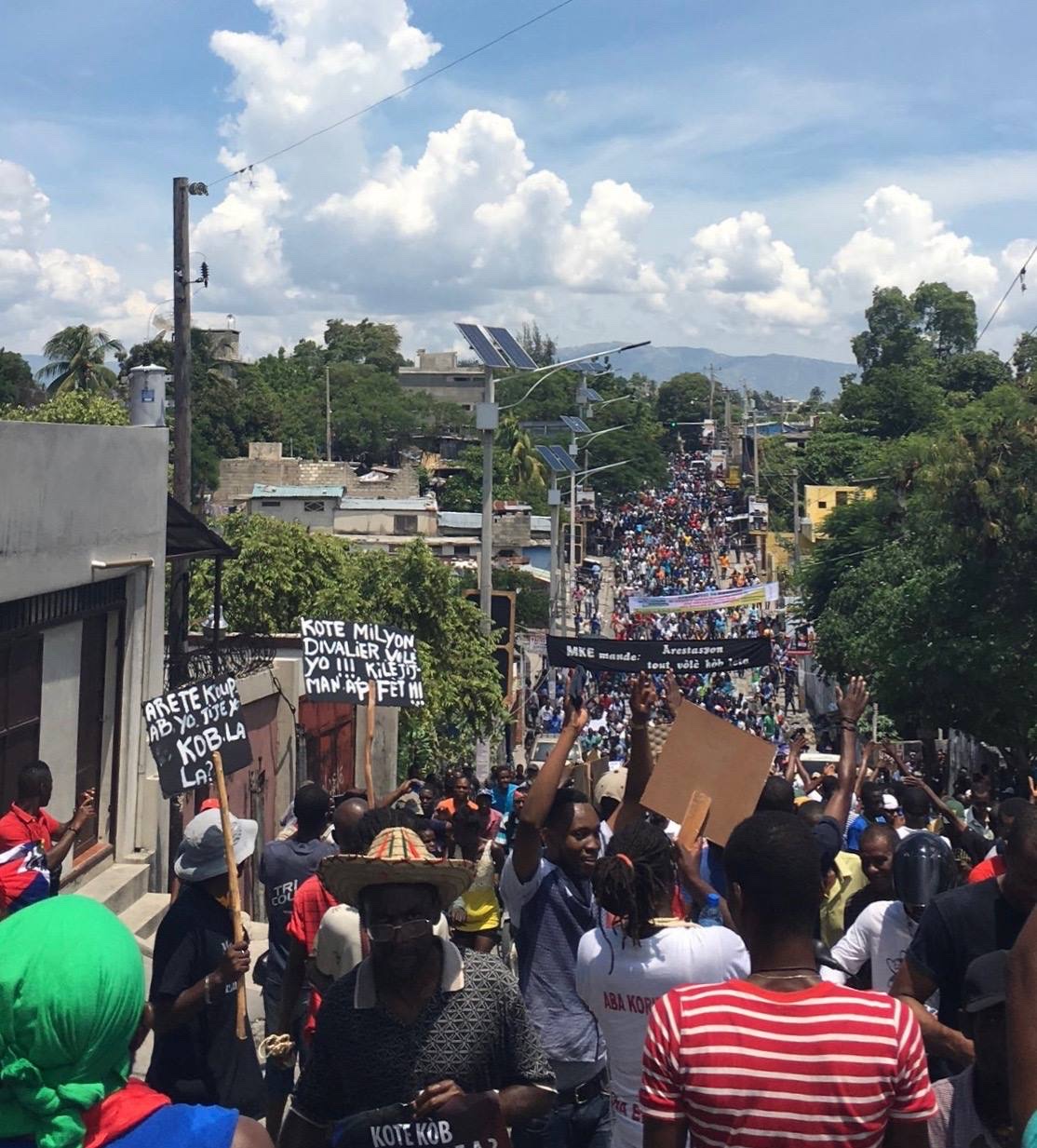
There is, however, a counter-example. On Friday 24 August 2018, hundreds of young people from the PetroCaribe movement held a sit-in outside the Superior Court of Auditors in Port-au-Prince to ask where the money from the Venezuelan programme had gone. The gathering passed without major incident or police intervention, according to accounts at the time. Born on social media with the slogan « Kot kòb PetroCaribe a ? » ("Where is the PetroCaribe money?"), the movement helped push the Court to publish its audits, starting with a first report in January 2019. The large marches that followed, however, were met with force.
Haitian precedents and the New York example point to a few conditions. For organisers: identifiable leaders (students, unions, associations), advance notice to the police, static gatherings outside an institution rather than barricades, marshals, no weapons, and the presence of human-rights observers and the press. For the state: written rules for policing protests, separate from anti-gang operations, a ban on firearms against peaceful crowds, and public investigations after every death or injury.
This article was corrected on November 17, 2026.
Videos
Watch now.
amNY, dissolution du SRG et réactions (16 nov. 2026)
CNN, « Mamdani disbands controversial NYPD unit » (16 nov. 2026)
Mag Haïti (Instagram), gaz lacrymogène contre les étudiants de la FASCH (16 nov. 2026)
NAGO News, Pétion-Ville : les étudiants de la FASCH face à la police (16 nov. 2026)
NAGO News, « Manifestations : la PNH prévient qu'elle appliquera la loi » (16 nov. 2026)
Constitution d'Haïti de 1987, article 31 (Georgetown University, PDBA)
NBC News, les gangs haïtiens classés organisations terroristes par Washington (2 mai 2025)
Le Nouvelliste, l'ONU sanctionne Viv Ansanm et Gran Grif (juillet 2025)
CPJ, « Haitian police kill 1 journalist, injure 2 at protest » (fév. 2022)
IPI, « Haitian journalist killed while reporting on protest » (fév. 2022)
CPJ, mort du journaliste Romelson Vilcin au commissariat de Delmas 33 (nov. 2022)
HaitiLibre, la PNH s'explique sur la mort du journaliste Vilcin (oct. 2022)
Le Nouvelliste, BINUH : plus de 1 400 morts et 656 blessés au deuxième trimestre 2026 (25 août 2026)
ONU Info, rapport du BINUH sur le deuxième trimestre 2026 (août 2026)
AP (via KSAT), 400 Mawozo annonce rejoindre une manifestation pacifique (7 nov. 2026)
Western University, Greg Beckett sur les manifestations de 2019 en Haïti (nov. 2019)
Africanews, manifestations PetroCaribe à Port-au-Prince (25 août 2018)
ICNC, « PetroCaribe : Haitian hope in the struggle against corruption » (juillet 2020)
Cour supérieure des comptes, rapport PetroCaribe n° 1 (31 janv. 2019)
Wikimedia Commons, « Manifestation Haiti » (Rony D'Haiti, 9 sept. 2018, CC BY-SA 4.0)
Comments 0