


"Killer robots": in Geneva, the UN pushes for a treaty on autonomous weapons
By Prisca Macena
3 min read
Should weapons that can select and kill a target without human intervention be banned? Since Monday 16 November, the states parties to the Convention on Certain Conventional Weapons have been meeting in Geneva, until 20 November, for their seventh review conference. At the heart of the debate: "killer robots", or lethal autonomous weapons systems.
UN Secretary-General António Guterres urged delegates from more than 120 countries to negotiate a legally binding instrument with "clear prohibitions and restrictions". "The nature of warfare is changing," he warned, calling on them to "take action to prevent the use and spread of these merciless weapons". He had set 2026 as the deadline for launching such negotiations.
UN human rights chief Volker Türk had insisted a few days earlier: "A machine must never have the power to decide whether a human being survives or dies." The International Committee of the Red Cross and Pope Leo XIV also back new rules.
Seven countries, including Austria, Brazil, Mexico and Ireland, have tabled a proposal for a new binding agreement, and the Stop Killer Robots coalition says 130 states support new rules. But major military powers are holding back. Russia says it is "premature" to argue that the time has come for such measures, and the United States wants to limit curbs on the development of military artificial intelligence.
France has long defended a "two-tier" approach: banning systems that escape all human control and regulating the rest. Paris rejects "fully autonomous" weapons, but analysts say its position has shifted and that it has become more reluctant about binding measures.
Haiti is not a stranger to this debate. Since 2025, a government-created task force made up of police units and private contractors has been striking gangs in Port-au-Prince with quadcopter drones carrying explosives. According to a Human Rights Watch report released on 10 March 2026, these strikes killed at least 1,243 people and injured 738 between 1 March 2025 and 21 January 2026; among the dead, 43 adults and 17 children were not believed to belong to a gang. The drones are guided by human operators: they are not autonomous weapons in the sense debated in Geneva, but they raise the same questions of human control, accountability and civilian protection. Haiti is not a party to the Convention on Certain Conventional Weapons; it did, however, vote for the UN General Assembly resolutions on lethal autonomous weapons systems in December 2024 and December 2025.
The convention works by consensus, so a single country can block an agreement. Delegates are due to decide by the end of the week whether to open negotiations. Activists say armed drones able to strike autonomously have already been used in some cases, notably in Ukraine and the Middle East.
Videos
Watch now.
Reporting by ONU Info, « Guterres calls for a legally binding instrument for 'killer robots' » (16 nov. 2026)
AP (WSLS), « UN-backed talks consider possible rules on lethal autonomous weapons » (16 nov. 2026)
Ifri, « Robots tueurs : l'heure des choix » (nov. 2026)
TF1 Info / LCI (Instagram), robots tueurs : la position de la France
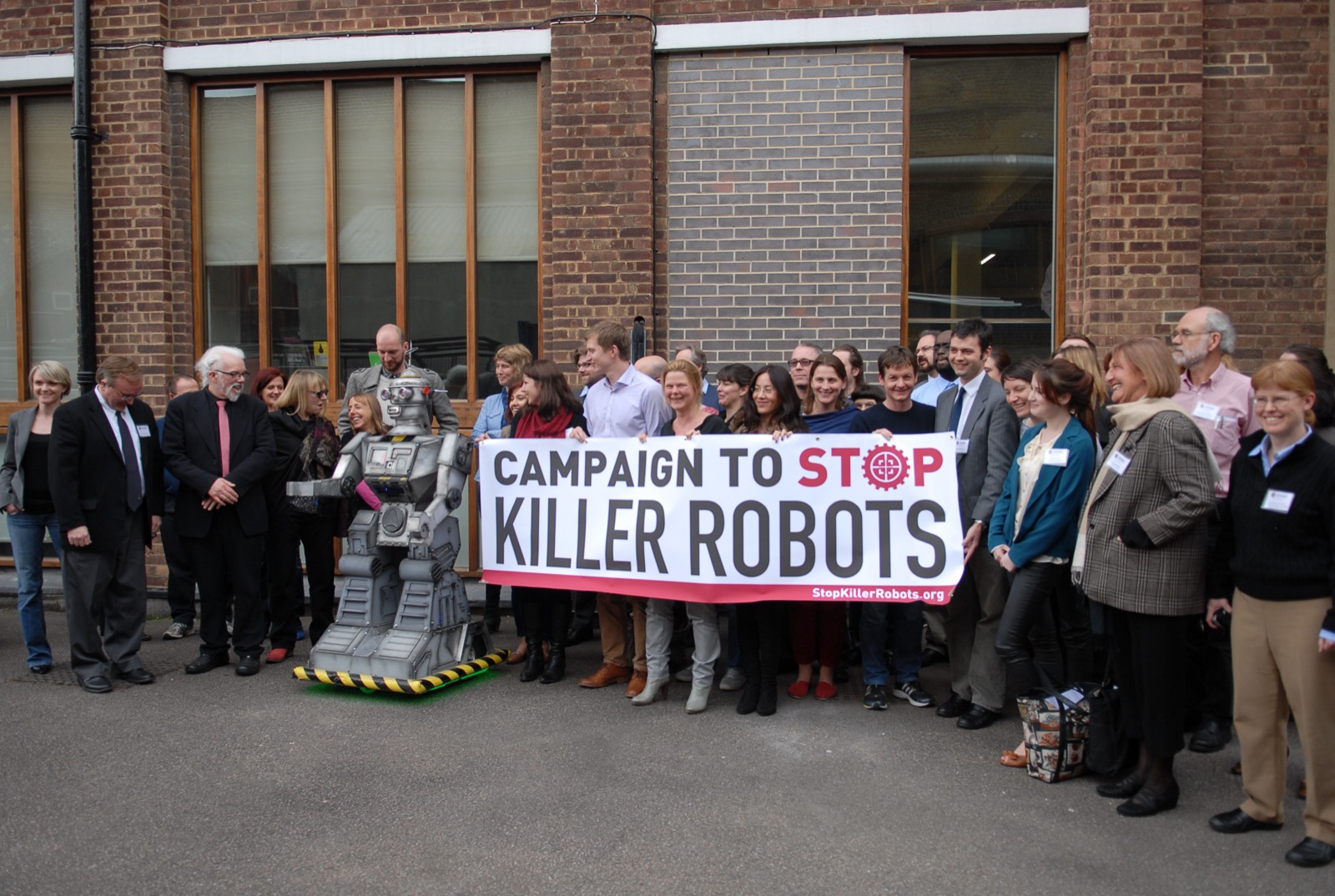
Image : Campaign to Stop Killer Robots, Wikimedia Commons (CC BY 2.0)
Al Jazeera, « Over 1,200 killed in Haiti drone strikes, including 60 civilians » (10 mars 2026)
AAP, « Hundreds of people killed in Haiti police drone strikes » (mars 2026)
ONU, vote de la résolution A/RES/80/57 sur les armes létales autonomes (1er déc. 2025)
UN Project, vote de la résolution A/RES/79/62 (2 déc. 2024)
Wikipedia, liste des États parties à la Convention sur certaines armes classiques
Landmine and Cluster Munition Monitor, Haïti (2022)
By Prisca Macena
Comments 0