


#NEWS · Live feed
Colombia: Cartagena hostages freed; has violence risen under De la Espriella? What the numbers say

By NAGO News
4 min read
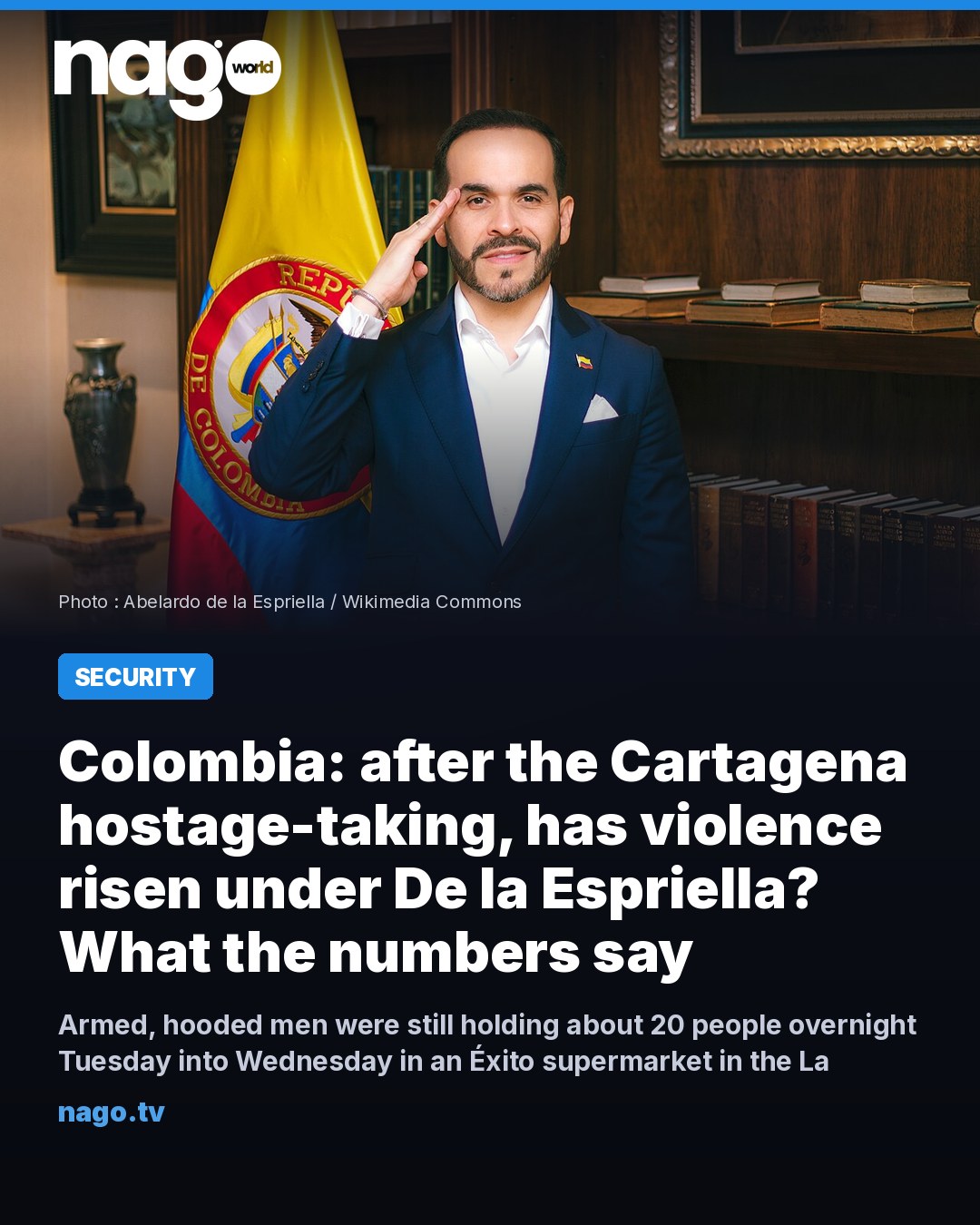
The hostage-taking at the Éxito supermarket in La Castellana, Cartagena, the big tourist city on Colombia’s Caribbean coast, ended overnight from Tuesday to Wednesday. At about 1:20 a.m. on 25 November, after several explosions, police and soldiers entered the store and freed all the hostages, more than sixteen hours after the siege began. No hostages or police officers were hurt. One of the attackers was killed and several others were arrested; the number varies by source. The gunmen had barricaded themselves inside on Tuesday morning after a failed attack on an armoured van. President Abelardo de la Espriella, who went to the scene, called the operation “absolutely impeccable” and described the attackers as ordinary “criminals”, not terrorists. The total number of hostages freed differs between authorities, from about twenty to more than seventy.
The day before, on Monday, 23 November, a car bomb exploded outside the Meta governor’s office in Villavicencio, injuring at least 23 people. The president blamed dissidents of the former FARC guerrillas. Such images suggest a country sliding into violence since the president took office on 7 August. The numbers tell a more nuanced story.
In his first three months (August to October 2026), compared with the same period in 2025, homicides fell by about 9 percent, kidnapping victims by 59 percent and armed clashes by 62 percent, according to official data analysed by the Colombian outlet La Silla Vacía. The Fundación Ideas para la Paz (FIP) also reports a drop of nearly 11 percent in homicides in August and September.
What has risen is armed groups’ attacks on the state. Terrorism cases went from 39 to 96 over the same period, explosive-drone attacks from 4 to 48, and attacks on infrastructure rose by 44 percent. Bomb and drone attacks, sometimes in cities, are far more visible than a homicide in a rural area.
This is no coincidence. On 11 September, Abelardo de la Espriella closed every negotiating table of the “total peace” launched by his predecessor, Gustavo Petro, and launched a military offensive, including airstrikes against dissident groups. According to the monitoring group ACLED, August 2026 was the deadliest month for clashes between the state and armed groups since its records began in 2018. International Crisis Group analyst Elizabeth Dickinson says the armed groups are trying to “raise the costs” of the offensive for the government, including by harming civilians.
The violence did not start with the new president. In 2025, under Gustavo Petro, Colombia recorded 14,780 homicides, the highest figure in a decade according to the national forensic institute. The year began with the Catatumbo crisis, where fighting left more than 80 dead and 32,000 displaced, and saw the assassination of candidate Miguel Uribe Turbay. According to the NGO Indepaz, 80 of the 97 massacres recorded in 2026 up to 9 October took place before 7 August, under Petro.
During “total peace”, fighting between the state and armed groups had fallen, but the groups expanded and grew stronger, according to ACLED. They now have about 29,000 members, according to the FIP. The FIP nevertheless says it is “impossible” to measure the new policy’s real effect after only 100 days, and notes that less violence does not necessarily mean the armed groups have lost control of territory.
Watch and share
The reel and the cards for social media.
Videos
Watch now.
Reporting by France 24, « Esto se sabe de la toma de rehenes en un supermercado de Cartagena » (25 November 2026)
Infobae, l’assaut du supermarché Éxito (25 November 2026)
France 24 English (Instagram), libération des otages (25 November 2026)
TV5MONDE Info (Instagram), libération des otages de Carthagène (25 November 2026)
El Tiempo, prise d’otages à l’Éxito de Cartagena, direct (24-25 November 2026)
Publimetro, « Éxito Cartagena : liberan a 10 rehenes » (24 November 2026)
Al Jazeera, voiture piégée à Villavicencio (24 November 2026)
La Silla Vacía, chiffres de sécurité après 100 jours (19 November 2026)
Fundación Ideas para la Paz, via EFE / La Patria (16 November 2026)
ACLED, « Total peace, prison or death » (2 September 2026)
El Colombiano, fin de la « paix totale » (11 September 2026)
Infobae, début 2026 le plus violent de la décennie (2 April 2026)
El Colombiano, 14 780 homicides en 2025
ACLED, « Total peace paradox » (28 November 2024)
Wikimedia Commons, photo d’Abelardo de la Espriella (CC0)
 Kenscoff: at least ten killed in a gang attack in Bongard, police launch an operationAt least ten people were killed and seven wounded by gunfire and machete blows on Wednesday, 25 November, in a gang attack in Bong…Flash – Les Cayes: several people reportedly arrested, including TikTok figure “Kika”; alleged gang links…Police reportedly arrested several people on Wednesday, 25 November, in Les Cayes, in the South department, among them “Kika”, a w…Belize still committed to sending troops to Haiti, its foreign minister saysBelize remains determined to send troops to Haiti, its Foreign Minister Francis Fonseca said on Tuesday, 24 November, when asked b…Nigeria: Kashim Shettima announces a ₦30 billion fund for young people and women in the North-EastNigeria’s Vice-President Kashim Shettima announced on Tuesday, 24 November, in Maiduguri, Borno State, the approval of a ₦30 billi…Iowa: US Army detonates nearly five tons of unstable lead azideThe US Army on Wednesday, 25 November, at about 9 a.m. local time, detonated nearly five tons of lead azide, an explosive that had…
Comments 0