


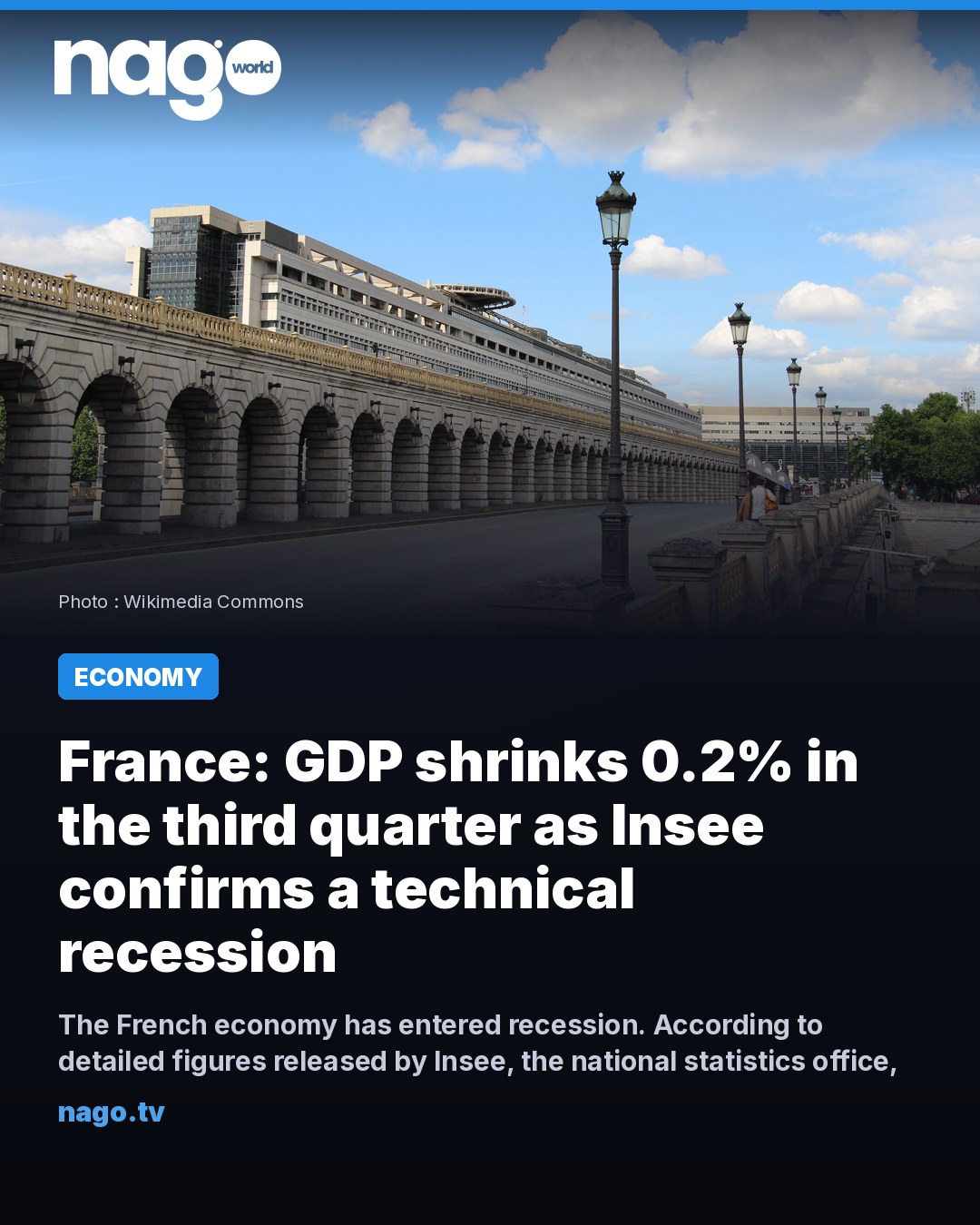
France: GDP shrinks 0.2% in the third quarter as Insee confirms a technical recession

By NAGO News
3 min read
The French economy has entered recession. According to detailed figures released by Insee, the national statistics office, on Friday 27 November, gross domestic product (GDP) fell 0.2% in the third quarter of 2026, a downward revision from the first estimate of -0.1% published at the end of October.
The second quarter, first reported as flat, now also shows a very slight decline once the data were refined: GDP went from €664.4 billion in the first quarter to €664.2 billion in the second, then to €662.6 billion in the third. With two consecutive quarters of decline, the definition of a so-called "technical" recession is met. « On peut dire qu'on a une récession » ("we can say we have a recession"), Marie Leclair, head of Insee's national accounts department, told a press briefing, while adding that it « ne change quand même pas vraiment le tableau général » ("doesn't really change the overall picture") of the economy. The first quarter had already shrunk by 0.2%.
Foreign trade weighs the most: exports contracted sharply (-1.6% after +2.9% in the second quarter), while imports barely grew (+0.1%). Their contribution to GDP growth was a negative 0.6 points. Investment fell again (-0.9% after -0.5%), dragged down by construction (-0.9%) and purchases of manufactured goods (-1.8%).
Household consumption, on the other hand, picked up slightly (+0.3% after +0.2%), and purchasing power per consumption unit rebounded (+0.2% after -0.5%). The savings rate remains high, at 17.4% of disposable income. Hours worked fell slightly again (-0.1%), and total employment was stable.
Public finances are also worsening. The general government's borrowing requirement reached 5.6% of GDP in the third quarter, up from 5.3% in the second. Spending rose sharply (+€3.7 billion), driven by social benefits and by higher interest payments on the debt (+€1.2 billion), while revenue slowed.
The government's target is slipping away. The growth carry-over for 2026, meaning annual growth if GDP stayed flat in the last quarter, is only 0.1%, against an official forecast of 0.5%. « Il faudrait 1,4 % de croissance au cours du dernier trimestre pour avoir une croissance de 0,5 % » ("it would take 1.4% growth in the last quarter to reach 0.5%") for the year, Marie Leclair noted. The first estimate for the fourth quarter is due at the end of January.
Watch and share
The reel and the cards for social media.
Videos
Watch now.
France 24, « La France entre en récession, le PIB continue de reculer » (27 November 2026)
Insee, première estimation du PIB du troisième trimestre 2026 (-0,1 %) (30 October 2026)
Complex (Instagram), « France has officially fallen into a recession » (27 November 2026)
Photo : Fred Romero (Wikimedia Commons) · CC BY 2.0
Comments 0