


#ÉDITORIAL · Live feed · Grand'Anse
Gangs have no hometown
4 min read
"Sou 100 % gang ki gen anba a, tout sòt Jeremi nèt" — "of all the gangs down there, every single one comes from Jérémie." The line has been spreading since the weekend in a video of singer Bob Cailloux, whose real name is Jean Michelet Blanc, shared by thousands of accounts. In the clips going around, the artist adds that any government should first "focus" on Jérémie, a place that, in his view, never produces good people.
We do not deny an artist the right to be angry. The capital lives under the rule of the gun, and anger is everywhere. But anger aimed at the wrong target protects no one. Accusing an entire city of giving birth to the gangs is false, it is unfair, and it is very convenient for those who truly profit from them.
It is false, first. The gangs that hold Port-au-Prince grew up in the capital's own neighbourhoods, and they recruit wherever poverty and neglect hand them recruits. According to UNICEF, up to half of armed group members are children. Child recruitment jumped by about 200 per cent in 2025, and the United Nations verified 892 cases that year. Those children do not come from a city. They come from hunger, from closed schools, from families driven out of their homes. Who can believe that a child from Cité Soleil or Martissant was sent by Jérémie?
It is unfair, next. Jérémie is no breeding ground for bandits. It is the City of Poets, the town of Etzer Vilaire and Émile Roumer, the birthplace of General Thomas-Alexandre Dumas, the novelist's father. It is also a town that has known violence as a victim, not as a perpetrator: in 1964, the "Jérémie Vespers" saw whole families massacred by Duvalier's militiamen. More recently, Hurricane Matthew in 2016 and the August 2021 earthquake devastated the Grand'Anse. Its people rebuilt without guns and without ransoms.
It is convenient, finally. Pointing at a city spares those who arm and fund the gangs. United Nations experts have for years described weapons smuggled into the country, money coming from political and business circles, and complicity reaching into the state. None of those responsible can be reduced to a birthplace. When fingers point at Jérémie, they are the ones who breathe easier.
Some will argue the artist spoke in the heat of the moment, or that he knows gang leaders who come from the Grand'Anse. Perhaps. But a man being born in Jérémie does not make Jérémie guilty. No one blames Gonaïves, Saint-Marc or Port-au-Prince when a criminal comes from there. Criminal responsibility is individual: that is the foundation of all justice.
A popular artist's words do not stay in the studio. They have consequences. Nearly one and a half million people are displaced in Haiti, according to the International Organization for Migration, and distrust of "people from elsewhere" is growing everywhere. People from Jérémie live in Port-au-Prince, Miami, Montreal and Paris. A sentence like this one can cost them a home, a job, or a glance that turns into suspicion at a checkpoint.
Let us be fair. Bob Cailloux called for no violence, and nothing we found links him to any armed group. He is voicing out loud an exasperation many people share. But exasperation is no excuse for inaccuracy, especially when you hold a microphone.
We ask him to withdraw or clarify these remarks, and we will publish his response if he wishes to give one. We ask the authorities to hunt the gangs by their names, their weapons and their financiers, not by their hometown. And we ask Haitians, at home and in the diaspora, to reject this geography of suspicion: it divides a people the gangs have already torn apart enough.
Gangs have no hometown. They have suppliers, patrons and accomplices. That is where we must look.
Videos
Watch now.
Reporting by UNICEF, « Les recrutements d'enfants en Haïti multipliés par trois en seulement un an » (12 févr. 2026)
BINUH et UNICEF, déclaration conjointe sur le recrutement d'enfants (juillet 2026)
ONU Info, l'OIM et les déplacés en Haïti (juin 2026)
Loop Haïti, « À la rencontre de Bob Cailloux »
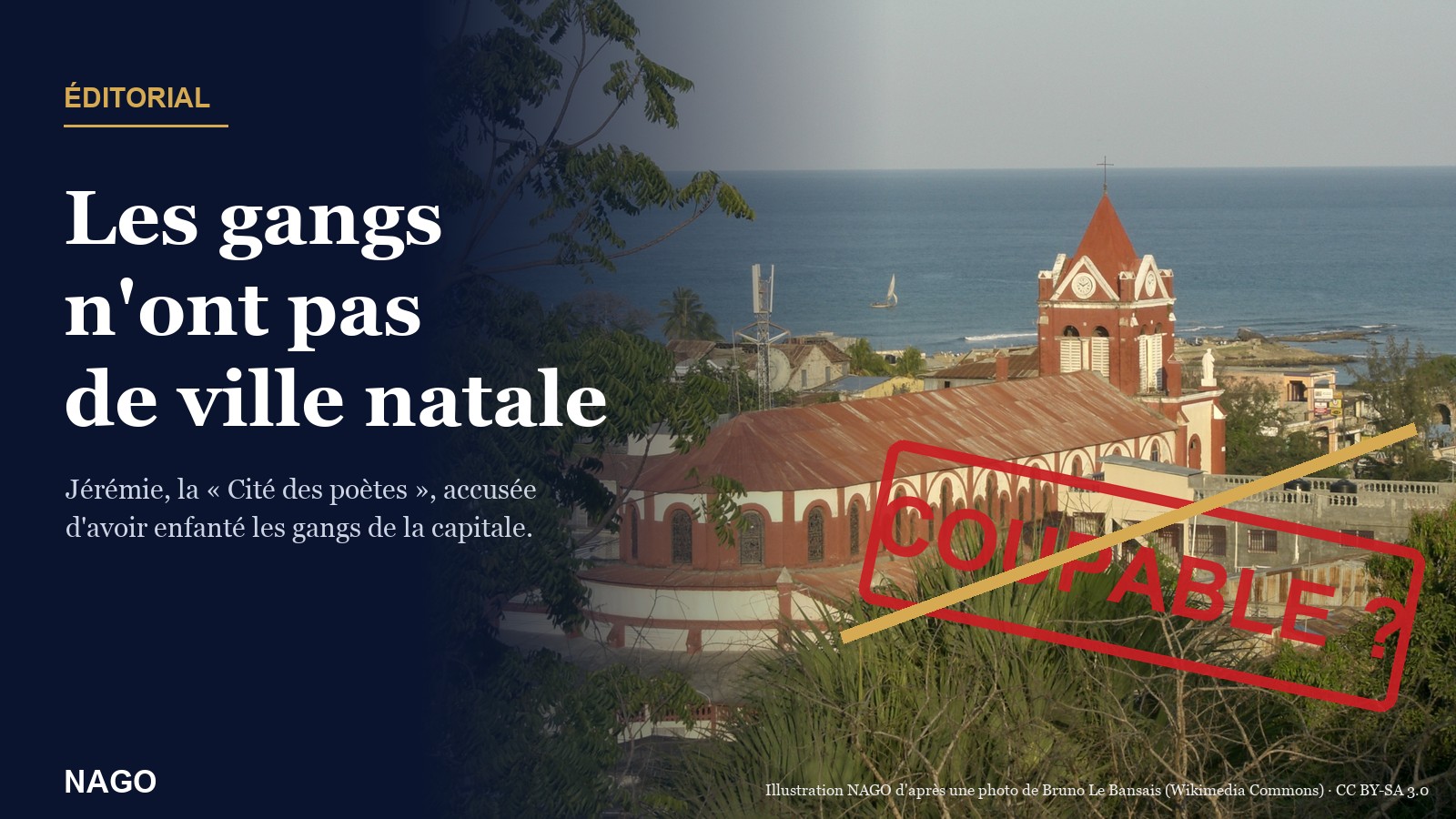
Illustration NAGO d'après une photo de Bruno Le Bansais (Wikimedia Commons) · CC BY-SA 3.0
Comments 0