


#NEWS · Live feed · Dominican Republic
Why must Black Dominicans prove they belong?
By NAGO News
4 min read
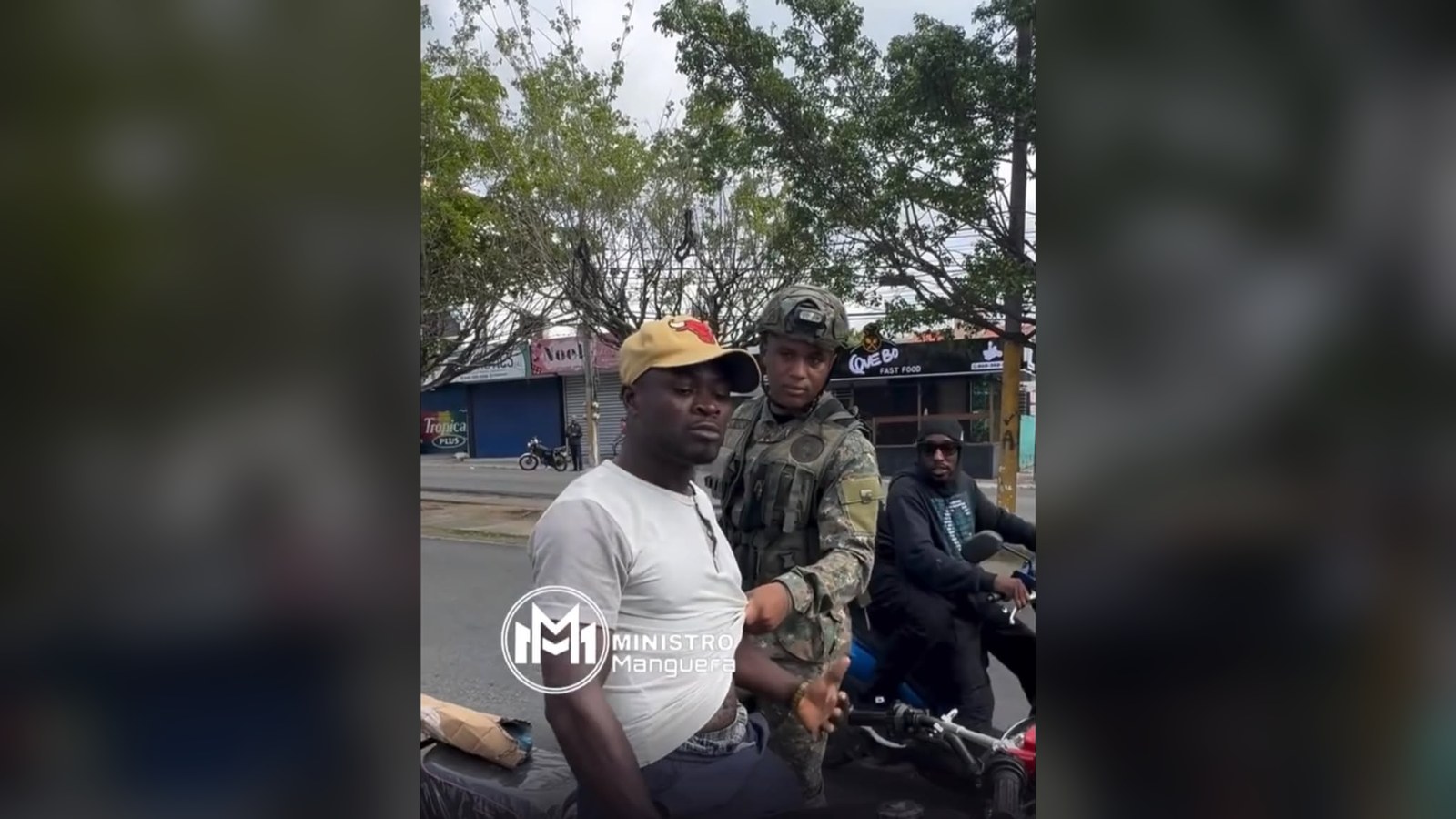
A video circulating on social media shows a dark-skinned motorcyclist in the Dominican Republic surrounded by uniformed officers, at least one of them in military fatigues, as his papers are checked. The footage does not show why he was stopped, and NAGO could not independently verify where or when it was filmed.
It has nonetheless revived a question asked for years: do Black Dominicans have to prove they are not foreigners? Surveys show that discrimination based on skin colour is rising, and several institutions have documented cases of Dominican citizens detained because they were thought to be undocumented Haitians. The Dominican government says its operations do not involve racial profiling.
What the numbers say
Nearly one in five Dominicans (18%) say they have felt discriminated against because of their skin colour at least once in the past five years, according to the 2023 AmericasBarometer, which surveyed 1,596 people between April and June 2023. 4% say it happens often. The share has risen eight points since 2010, the last time the question was asked in the country.
The gap by skin tone, recorded by the interviewer on a standard colour palette, is stark: 12% of those with the lightest skin report discrimination, against 66% of those with the darkest. The same report notes that the Dominican Republic remains among the countries in the region with the lowest rate, while stressing that the survey measures perceptions and does not necessarily mean discrimination is less common there. These figures concern discrimination in general, not immigration stops.
Citizens detained as "Haitians"
In its 2023 human rights report on the Dominican Republic, the US State Department wrote that migration agents, police and other security forces arbitrarily detained people of Haitian descent on the basis of their skin colour, accent, place of residence or name.
The report cites observers who said Dominican citizens and legal Haitian residents were detained on suspicion of being undocumented and taken to migration detention centres before the authorities checked their status and released them. Some were even wrongfully deported before they could prove their citizenship. It also describes checkpoints where travellers must show their papers, and hospitals that gave pink birth certificates, meant for foreigners, to children of Dominican parents assumed to be Haitian because of their skin colour, accent or name.
The IACHR's warning in February
On 6 February 2026, the Inter-American Commission on Human Rights (IACHR) reiterated its concern about Dominican immigration policies. According to information it received from civil society, Dominicans of Haitian descent, particularly Afro-descendants, "are perceived to be Haitian, based on an apparent use of racial profiling" by the authorities in immigration operations. The Commission added that the lack of statistics makes it impossible to know the scale.
The IACHR also noted that, according to the Directorate General of Migration (DGM), 310,499 Haitians were deported from the Dominican Republic in the first ten months of 2025. Deportations continue: in October 2026, the DGM expelled 40,521 of the 44,414 Haitians it detained.
Santo Domingo's position
Before the IACHR, the Dominican State said there is neither a discriminatory policy nor racial profiling, and that immigration operations respond to risks to national security and public order. It added that the procedures are temporary and serve to determine whether those affected meet the legal requirements to stay. The Commission noted that these statements were not backed by official data.
In a response published on 7 February, the Dominican foreign ministry defended "the legitimate need to manage in an orderly way" what it considers an extraordinary migration flow, and said that this power is exercised in line with the Constitution and the law.
Citizenship that is hard to prove
Papers have weighed heavily since the Constitutional Court's ruling 168-13 in September 2013, which retroactively stripped Dominican nationality from people born in the country to foreign parents without legal status, most of them of Haitian descent. Law 169-14, passed in 2014 to fix the situation, is still poorly implemented, according to the IACHR, leaving many Dominicans of Haitian descent with no simple way to prove their nationality.
In the video, nothing shows whether the motorcyclist is Dominican or Haitian, or why he was stopped. That is precisely what rights groups are asking: on what grounds do officers decide who has to show their papers?
Videos
Watch now.
Reporting by Vidéo du contrôle (Instagram, novembre 2026) — lieu et date non vérifiés
Département d'État des États-Unis, rapport 2023 sur les droits humains : République dominicaine
Wikipedia, Juliana Deguis (affaire à l'origine de l'arrêt TC/0168/13)
NAGO News, « La République dominicaine expulse 40 521 des 44 414 Haïtiens interpellés en octobre »
By NAGO News
Comments 0